The Kid Is Not My Son
My father’s dishonesty was frustrating and disappointing to many people, but I think he got the worst of it. Here’s a dharma talk I gave to New Paltz Zen Center and Village Zendo on May 10, 2026.
Transcript #
One of my goals in this talk is to not act out the role of the Dharma speaker, but talk about the Dharma instead. And another goal is to completely exhale, at least a few times.
I first talked to my father when I was 23.
My parents split up when I was an infant, and I’d had no contact with him before then. My parents met at the age of 18 at the Abbie Hoffman levitating-the-Pentagon protest. They were both arrested the night they met. Sometime later, they got back in touch in New York City. They worked in the peace movement together for years. They got married. Eventually, they moved to Vermont. I knew that my father had been a ski instructor, race car mechanic, just an astonishingly competent person…who didn’t want to be a father. My parents’ marriage was already in decline when my mom got pregnant. They split soon after I was born. Then they separated for good, and my mom raised me solo. We bounced around the country during my childhood while she was building her academic career.
Growing up, I had a normal relationship with his parents, my paternal grandparents, Fran and Ollie. We talked on the phone regularly. I saw them once or twice a year as a kid. But I never asked them about my father, and I don’t think they ever mentioned him to me. Once when I was about 18, in their house, I stumbled across a photo of him. I was in a bedroom or something. It was one of the few photos that I’d seen of him. My mother had always told me how much I looked like him. And in this photo that I suddenly found, I could really see it: He has bags under his eyes, always looks a little bit tired like me, got thick lips, and long, brown, wavy hair. I had long, brown, wavy hair at that time. For some reason, I didn’t mention to my grandparents that I’d seen this photo. I just kind of snuck back out of the room. I don’t know why. My grandparents never said, “We are not going to talk about Rick.” I think that when we’re kids, when we grow up with silences, we somehow learn, before words, maybe, what subjects to be cautious about.
At some point in my teens, I decided that I absolutely had to meet him, and it was up to me to make this happen. At any moment, I could have asked Grandma and Grandpa, what’s my father’s phone number? And at any moment, it was always too scary to do. I put it off till the next moment, year after year.
By the time I was 23, I was living in Austin, Texas. I’d started Zen practice, I was doing all kinds of self-help stuff, and I had the support that I needed to take this plunge, or at least to walk onto the diving board. So I called my grandparents. Grandma Fran picked up. I asked for my dad’s phone number, and she gave it to me.
The next day, I went over to my friend Mike’s place. I asked him to help me decide how I was going to do this phone call. The way I remember it, we were sitting in Mike’s living room, and he said, “Well, do you have his number now?” I said, yes. Mike said, “I’m happy to have a conversation with you about talking to your father, or you could just call him.” My memory is he’s holding up my little silver flip phone with the antenna pulled out. I don’t know why Mike would be holding up my phone to me. I think this is like my memory playing movie director to make it more dramatic. But anyway, I took a breath and I called him.
This gentle, kind of high-pitched male voice answered the phone. He said, “Hello?” I said, hi, is this Rick? He said, “Yes, it is.” And I said, this is Jesse. This is your son. And he said, “I’m so glad you called.”
I think we only talked for a couple of minutes. Mike was right there. It was all too intense. I just said, I’m going to call you back later. But we agreed to talk and email some more. And he said again before I hung up, “I’m so glad you called.”
For the next few years, I had a really nice relationship with him. He invited me that Christmas to come visit him and his girlfriend in Vermont. My mom’s Jewish, so I was free, so I went. I flew to an airport in New Hampshire, and he picked me up at baggage claim. And there he was. This little man, shorter and skinnier than me. The eyes, the mouth, the wavy brown hair, starting to go a little gray at the temples. He stood straight and still, with his feet together like a dancer. We hugged.
We were really fortunate. We had the ideal situation for two men to have a serious conversation: we had a drive, in the dark, together, for at least an hour, from New Hampshire to Vermont. And for that hour, my father was totally real with me. He described what it had been like when I was born. He had not meant to be a father, but he intended to give it a try. But then, when I was an infant, he said, I just seemed like an alien to him. He was afraid of me. He could hardly even touch me. It was just impossible for him.
I felt like I got it. He grew up without his dad, too. He had a stepfather he didn’t like. I grew up without a dad. He had no siblings. Neither did I. I’ve practically never held a baby or touched a baby. They terrify me. I would be terrified. I get it. Whatever happened between him and my mom is their business, and I don’t have anything to forgive. I just wanted a relationship with him then.
We spent a few days together over Christmas. We went cross-country skiing together. He made me cappuccinos in his fancy machine. His girlfriend was great. Dad showed me his guitar-making workshop. After my mom and he split up, he’d ordered a guitar kit from Martin. He liked building it, and in not very much time, became one of America’s premier fine guitar makers and the president of the Luthiers Association. This is just what he was like: he was just good at everything.
I saw so much of myself in him. A certain finickiness or precision in the way that he spoke and moved and positioned his body, the way he crossed his legs when he sat. I felt like—I’m a lot like my mom in a lot of ways, but there are many ways in which I’m very unlike her, and watching him, I could see where these aspects of me had come from through my DNA. I wondered if somebody who seemed so much like me, maybe his experience of being alive was like my experience. Knowing him made me feel less alone.
You’re waiting for the other shoe to drop, and I shall now drop that shoe. Over the next 10 years, he was very, very frustrating to have a relationship with. I always addressed my emails and letters to “Dad,” and he always signed his replies, “Rick.” I knew he wanted to maintain this line for himself. And that was okay. He never called me on my birthday. I called him on my birthday and said, wish me a happy birthday. I was the adult. I took responsibility for our relationship, and I was willing to do that.
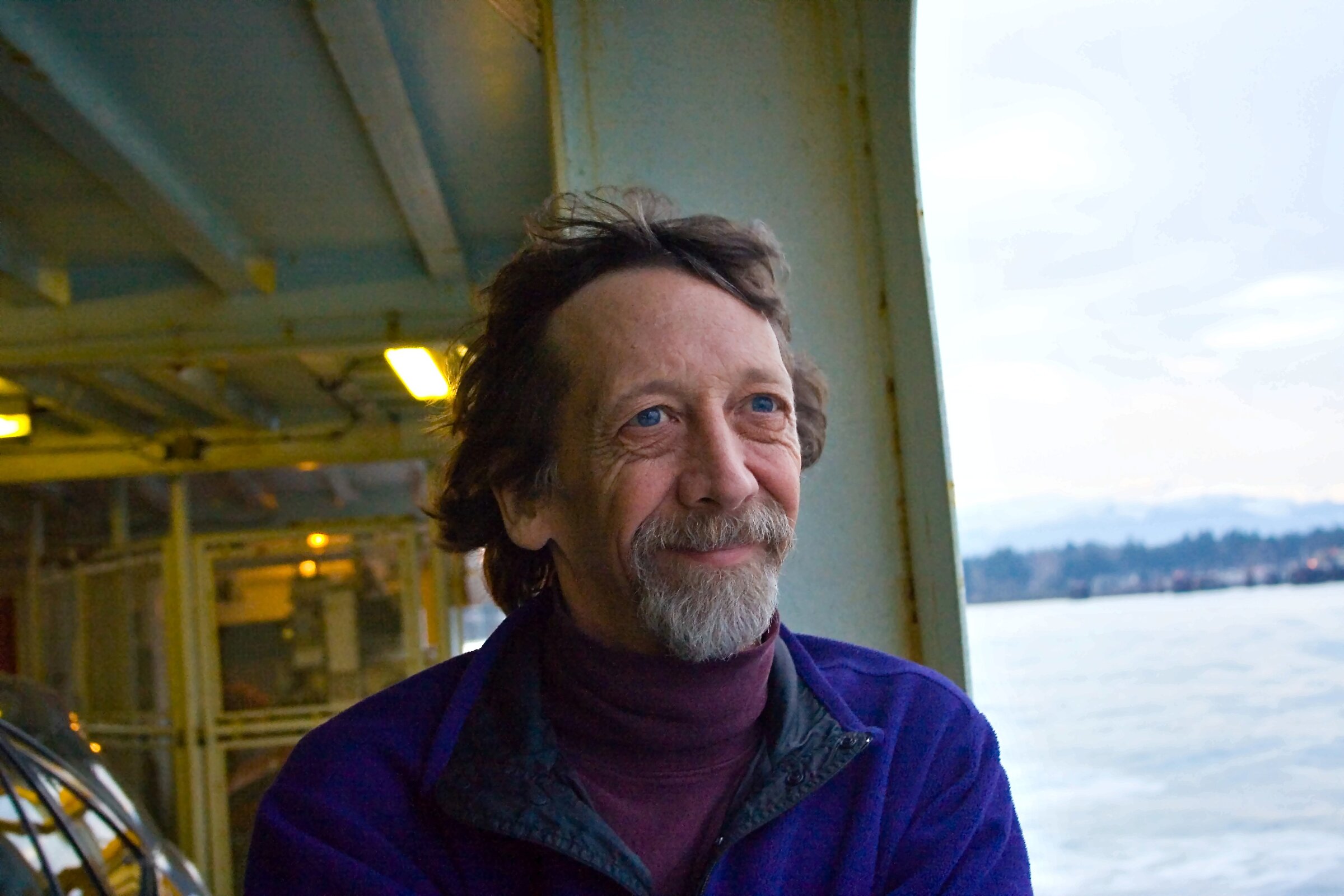
I visited him a second time, in 2007. By this time, he had met a new partner, Catherine. They’d moved from Vermont to Seattle together. I spent a day with him in Seattle. It was great to be together. We took a ferry to an island near Seattle. I was getting into photography. I took a photo of him on the ferry. I took a photo of him standing next to a lighthouse. He looks great in these photos. He’s still got the brown hair, blowing in the wind. He’s wearing a blue L.L. Bean fleece that matches his eyes. But in the photos now, I’ve been looking at them a lot, and he just seems worried. He seems stiff. His smile seems forced. That whole day, he kept stepping away from me to talk to Catherine on his cell phone. Something was stressing him out so much. He had chronic hiccups all day long. Really painful. A problem he’s had all his life that mom had told me about. Something was not right for him.
Five years later, 2012, I had met my partner, Keishin. We went to Seattle to visit him again. And he just acted so weird. We told him months ahead of time. We’d bought plane tickets. When can you meet us? What do you want to do? He would not be pinned down. He kept saying, “I’m so busy. Let’s play it by ear.”
Finally, he agreed to have dinner with us. Keishin and I sat in the restaurant waiting for him. And Keishin spotted him first walking past the window to the door. She’d not seen a photo of him before, but she just said, there goes your father. The resemblance was so obvious to her.
We had a lovely dinner. He’s funny and courteous and well-read and a great storyteller. Total charmer once you manage to tie him down into a chair across from you. But I was done with him. I got the sense that he didn’t actually want a relationship with me. He didn’t want to admit it, but he didn’t want it. And so I stopped trying to make that happen.
I saw him one more time, the final time, when his father died. Stepfather. And then when his mother died, Grandma Fran, it was during the pandemic, there was no memorial. Dad was briefly very sweet with me on email. He sent me some of Fran’s stuff. He found out that I’d gotten into rock climbing. He’d been a rock climber in the 70s. He sent a few classic guidebooks that he had from his collection. They were real pieces of climbing history. It was a really warm, thoughtful gesture. But I wasn’t going to be taken in anymore. I’d gotten really jaded. I enjoyed the warmth, but I didn’t try to keep it going.
So a few weeks ago, I was out climbing on a Friday, and it started raining. So I came home early and checked my email. And there was an email with a subject line, Rick Davis Memorial. It was from Catherine. And it said,
I’m writing to inform you that Rick Davis passed away on Feb 16. I don’t know how he left things with you, but I thought you might want to know.
So that’s how I found out that my father had died, two months after it happened. I wrote back,
Wow. Thank you. I’m sorry for your loss. Dad and I weren’t angry at each other, I just didn’t think he wanted a relationship with me so I stopped trying many years ago.
She wrote to me,
You do know he’s not your biological father, right? He said he told you.
And she included her phone number.
So I called her right away. We’d never met. We’d never talked. I called Catherine, I said, what evidence do you have that I’m not his son? Well, he had told her that I’m not. So I sent her some photos of me. And I think she pretty quickly concluded that, yup, I’m Rick’s son. And he had lied to her for 20 years.
We pieced together what had happened. He told Catherine that my mother had tricked him into thinking that I’m his son. According to my father’s story, Mom had an affair with somebody. But my father figured out that I’m not his son. And then (according to my father’s story) my father told me that I’m not his son, the second time I visited him in 2007. After that, my father pretended to Catherine that he and I had cut off communication. But that wasn’t true. In fact, my father was sneaking around Catherine’s back to occasionally see me and talk with me, while pretending to her that he wasn’t. So that’s at least partly why he was acting so weird. He was spinning plates. He was trying to keep all the stories from getting crossed. He couldn’t let me meet Catherine because all the plates would fall.
After I found out about this, I walked around for a week obsessed. I kept looking in the mirror thinking, like, I’m not imagining it, I really do look like him. I checked a 23andMe test that I had done years ago just to double check. Yes, I am half Jewish, half British. And I wondered, why wouldn’t somebody be proud to call me his son? I’m not smart enough? I’m not accomplished enough? There’s something wrong with me? Sometimes when I’d be talking with friends or climbing a cliff, I’d suddenly step outside and look at myself and think, look at me go. Who wouldn’t be proud to be my father?
I talked with everyone about this story. I talked with Mom, of course. Talked with Catherine again, and we emailed. I kept thinking of new questions and piecing together new parts of this story. This felt necessary to me, to understand the truth. I feel a responsibility to uncover it. Even though I wasn’t the one who lied, I feel a responsibility for untangling that lie. Straightening it out is cathartic to me. That’s one reason why I’m talking about this in public, where it’s going to be recorded and put on a podcast and put on YouTube. It’s very uncomfortable. But it also just feels right to explain this in public.
The other thing that was really cathartic to me was to go around singing,
Billie Jean is not my lover (ooh)
She’s just a girl who claims that I am the one
But the kid is not my son (whoo!)
It’s fun! It’s a fun story. And now I’m ok.
Then showed a photo of a baby cryin’, his eyes were like mine (oh no)
Go and dance on the floor in the round (ow!)
Non-lying is one of the ten grave precepts of Zen. The easy and obvious meaning of the precepts is that they’re guidelines for not hurting each other. I’m so sorry for what Catherine’s learned about her husband now. For my mother, who found out that she’d been accused of lying—my mother the Quaker, the ethicist, who builds her whole life upon truth telling. For me, for everyone who loved my father and is disappointed in him. I’m left trying to decide what to feel. Like, I was so excited when I was 23 to meet this man. We could have just been great friends. I wasn’t asking anything more of him. I gave up on him a long time ago, but, you know, it’s always possible that things could change. And now it’s too late, and I suddenly miss him, weirdly.
I’m sure that the suffering that he created for himself was the worst. My guess, my theory, is that he was at first ashamed for having not been in my life for my first 23 years. And so he didn’t tell Catherine when they met that he had this son. Then when I was planning to visit him in Seattle, he just panicked and he made up this story. And then he made up more stories to patch up the leaks. He just tied himself up in knots, and he was never brave enough to just stop. Just let it disintegrate. Just let the truth be revealed.
Someone wrote a book about him! A biography about him and his guitar making. And it’s just called Guitar. And dad had to lie to his biographer. He couldn’t even mention my mother, whom he’d been married to for 10 years, because then, of course, the biographer would call her and find out about me, and then Catherine would find out about me, and the whole thing would fall apart. So not even the book is his real life.
That’s karma. That’s what Buddha said would happen when we break the precepts—it starts this ball rolling. It’s not wrong to lie, it’s just that we suffer the consequences.
Enkyo Roshi wrote, “We’re not separate from the acts that we perform that create what will happen next.” Our shuso Monshin just shared this quote with us. It’s a concise description of karma. “We’re not separate from the acts that we perform that create what will happen next.” We create karma and karma creates us, reincarnation after reincarnation, breath after breath.
I think an even deeper damage of lying, besides the suffering it causes, is just that when we lie, we’re not living our real life. Dad spent decades not living his real life. Like, I imagine how it could have been with us, you know, me and him and mom and Catherine, we could have all just known each other. I’m sure Catherine would have forgiven him, like, “Yeah, you were a deadbeat for a while but that was a long time ago and it’s all over now.” I somehow feel like that alternative is Dad’s real life. He didn’t live it because he was so attached to the fake life.
I’m trying to live my real life. Meditation is trying to live real life.
It’s very hard for me to meditate in the morning, because as soon as I sit down on my cushion I’m trying to build up a life that I won’t be ashamed of, and I’m thinking of all the emails I need to send, the things I need to pack, the things I have to accomplish today, this month, this lifetime, so that I’ll be good enough. I’m worried: am I making the right choices, am I accomplishing enough? It’s excruciating. I cannot wait for the timer to go off so I can go downstairs, make some coffee, start answering some emails and checking things off lists. For more than half of my life I’ve been trying to calm down my mind with meditation.
Last year Keishin and I did a couple of jhana retreats and it transformed my practice. I talked about this in another dharma talk a while ago—look for “Speak Up If You’re Stuck in a Zazen Rut.”
How I practice in the morning is this: I sit down, I immediately start to worry and plan, and I just tell myself, I’m okay, I’ve done nothing wrong. That gives me the strength to take the plunge. I go into the anxiety and I let myself be that anxiety completely. It’s not anxiety-the-emotion for very long. It’s something before words, something primitive. It’s sensation. My body—I’m feeling it now—my body is tingling, my heart is racing, I’m vibrating. It’s like I’m about to burst into flames. I just sit with that for an hour in the morning. I search for every little way that I’m bracing myself against it, every little resistance, every stick of the wall that I built, and I drop them, I relax them, I breathe them out. I let the anxiety grow and we just become each other. At some point maybe I’m lifting off and it’s pleasure and it’s relief. I understand why meditators say that they are levitating, or that their heart is glowing with light.
Other days it’s just excruciating and I’m so relieved when it’s over.
But because I start the day with this commitment to live my real life, no matter what it is, everything’s becoming different. Like, I feel like I’m falling in love with my friends. Sometimes when I’m having a conversation with my colleagues about computer science, the joy of talking about ideas, it’s like I’m melting into the warm, physical pleasure of talking about ideas. I’ve poked all these holes in the story of my life and the emotions are pouring into those holes.
I don’t know if this is making sense. This is not a thing that’s happening in words. I’m doing my best! I will leave you with what Dogen said about non-lying. Dogen said about the precept of non-lying:
The Dharma Wheel turns from the beginning. There is neither surplus nor lack. The whole universe is moistened with nectar, and the truth is ready to harvest.