Keep the Dharma Wheel Rolling
This is a dharma talk I gave at the New Paltz Zen Center on June 19, 2026. It was during a meditation retreat which will end with our student Monshin’s first dharma talk. Play the audio below, or read the transcript below that.
Hi. I’m reading from my iPad. I prefer printing it out and reading from paper, but our printer ran out of ink yesterday. I’m kind of running on empty, too. I think a lot of people are feeling that way this week. I was kind of resenting that this sesshin was even scheduled at this time, when Keishin and I had just been on work trips and we just moved houses, et cetera. And then, of course, now I’m in it, and there’s no place I’d rather be. It’s flawless timing. I love doing jundo, and I was especially feeling this morning that kind of ASMR intimacy of whispering those little chants together—and I can say it now without ruining it, because we’re not going to do it again. So I’m glad we did it, I’m glad we didn’t miss it.
I got back from India last week, on Tuesday, and one of the last things I did in India was to visit this modern Shiva temple called the Adiyogi statue. It’s the biggest statue of Shiva, probably one of the biggest statues of anybody on earth. It’s just the bust—it’s just the head and shoulders of Shiva, and it’s 112 feet tall! It was finished about 10 years ago. It’s made out of black concrete. Shiva looks young and sexy and androgynous and serene. He’s got his eyes closed and his head thrown back. He’s got a smile. He’s got his long hair—Shiva’s hair is the source of the Ganges, so it looks like a stream of water. He’s wearing gold hoop earrings that must be seven feet in diameter. And he’s got a silver crescent moon attached to the top of his head. All the symbolism of Shiva.
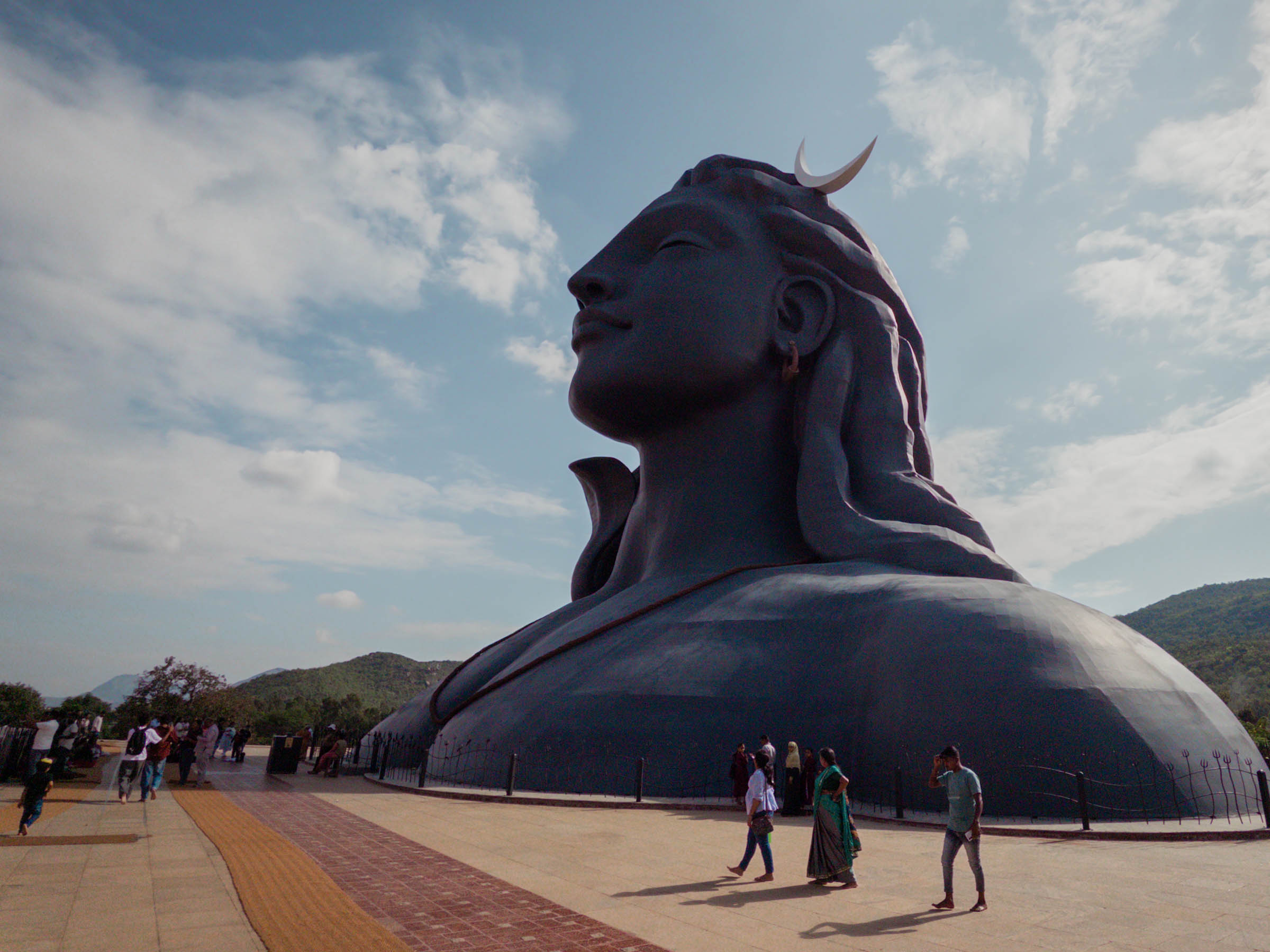
The Adiyogi statue.
And he’s raised up on a plinth the size of a tennis court. You can walk up a few flights of steps till you’re level with his shoulders, and then walk around him, circumambulate him—always clockwise. Everybody always circumambulates clockwise.
So this Shiva is the main attraction of this yoga center that was built by a celebrity guru. But I found particularly interesting this much smaller structure on the same site, which is one of the first things you see in the parking lot. It’s this little brick building. It’s about this size—actually, it’s smaller than this. And it looks like a cart. It’s got four big metal wheels attached to the outside of it. It’s got a gigantic trident sticking up out of the top of it—that’s another Shiva symbol. And a little door where you go in. You can walk around a Shiva lingam, which is another symbol of him. It’s this little pillar, round pillar. You go around it clockwise.
And so I went in, and I went around it clockwise. And then, when I got out, to my surprise, I saw that there was a young guy turning the wheels on the outside of the cart. I hadn’t realized that they could move, that they weren’t just decoration. They must weigh half a ton—they look like they’re made of metal. He was really working to get the thing moving. And, of course, he was turning this wheel clockwise. That clockwise wheel-turning symbol is universal in Indian spirituality. His buddy was filming him on his phone for TikTok, which is also a universal ritual.
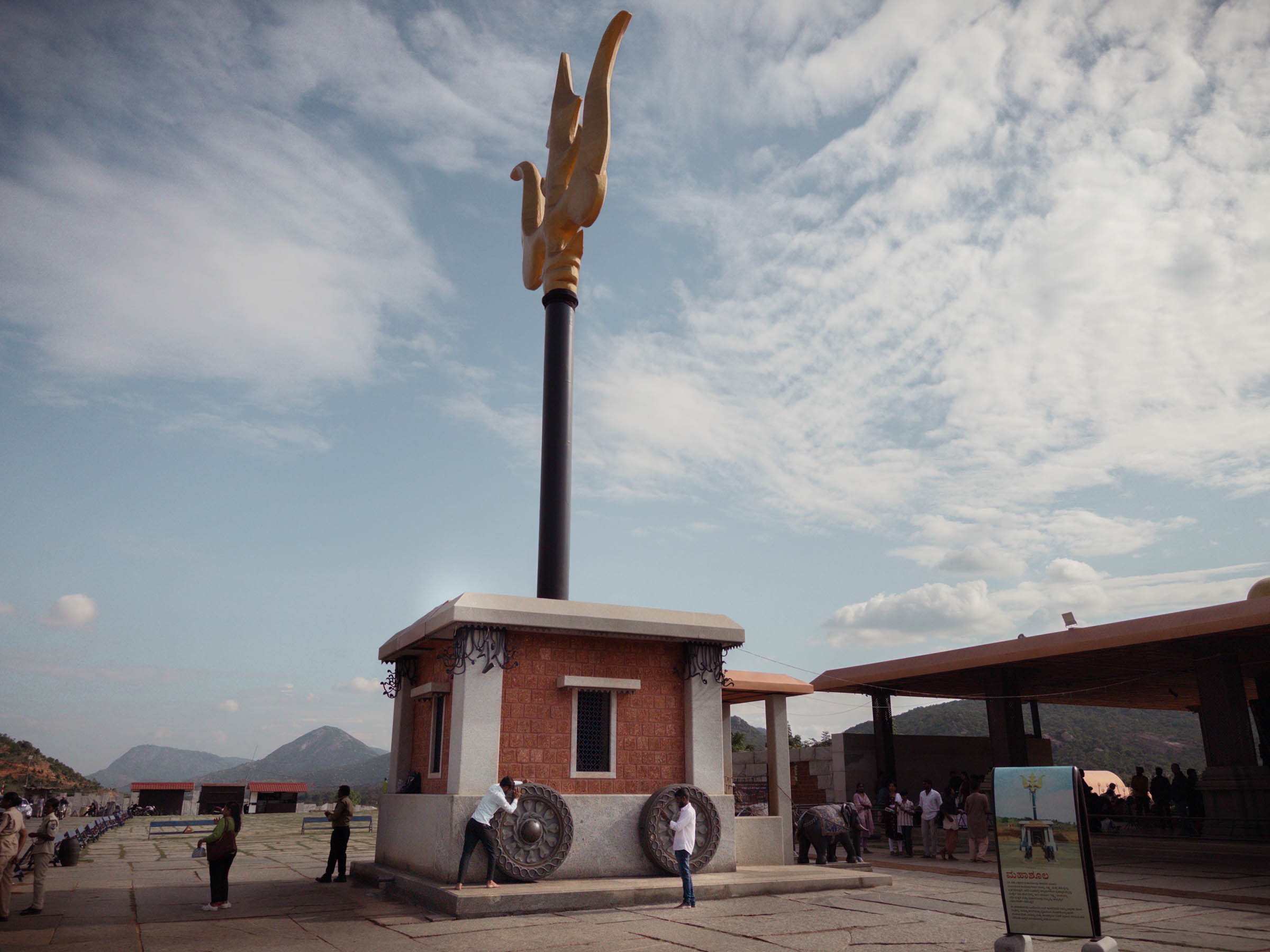
The little wagon shrine, with Shiva’s trident on top and a lingam inside. Its wheels actually turn.
On this whole trip—I was in Nepal and India—I was constantly noticing these symbols and rituals and words and ideas that are so old, that we share as Buddhists, as members of the Indo-European civilization, that go back like 5,000 years that we even know of. Which are still present today because of the meticulous preservation, transmission, and development of these ideas and these teachings, from person to person, for hundreds and hundreds of generations. And it was just awe-inspiring.
So, for example, the idea of turning the Dharma wheel. When did Buddhism start? It wasn’t exactly when Buddha got enlightened under the Bodhi tree, right? It wasn’t an ism yet. I think Buddhism starts about two months later, when he reaches Deer Park in Sarnath. And he meets up with his five old buddies, and they’re like, “You look different. What happened?” And he expounds: Four Noble Truths, Eightfold Path. And this talk that he gave is called the Dhammacakkappavattana Sutta in Pali, the “Dharma Wheel Starts Rolling Talk.” It’s when he set in motion this process of spreading the Dharma, developing it. And we symbolize this process as rolling a wheel.
But, of course, we’re not the only people who use that symbolism. The Hindus do, so do the Sikhs and Jains, everybody in India. I think kind of everybody who descends in any way from those first cart builders of the Proto-Indo-European civilization all think of a turning wheel as this sacred, fundamental symbol of spiritual progress.
On this trip I got really interested in these shared origins of Indian and European cultures, so I’m reading a book about the Proto-Indo-European language. The word “wheel” is incredibly ancient. People living sort of around Ukraine five or six thousand years ago had a word, kwel, which means turn, and they called wheels kwelkwelos, the thing that goes turn-turn. And that becomes, in Sanskrit, kwelkwelo, then keklo, then cheklo, then chakra, a word we know—and in Pali, chakka. That same kwelkwelo becomes kyklos in Greek and then cycle in English. Maybe also circus, via Latin. There’s some debate about whether that’s really the same root or not. And then in the early Germanic languages, that kwel turn-word becomes khwel and then wheel. And we can still hear that khw in British English, and Americans of the Southern accent say “wheel” with an audible “h.” And so that “h” is still a remnant of that at least five-thousand-year-old word, kwel. And it’s passed down from person to person, hundreds of generations—we’re still using that word today. Like, it literally is giving me shivers right now.
So forgive me. Intellectually understanding the world is how I express my love for being, and explaining is my love language to you. So I can’t help myself.
What actually is turning the Dharma wheel, right? What’s the meaning of this symbol? Turning the Dharma wheel is moving the Dharma forward, and that is both preserving and maintaining it as it is—this responsibility that we have to our ancestors, to preserve the thing that they have given us. But it’s also developing and innovating it, translating it, giving new Dharma talks rather than just reciting the old sutras, right? You have to roll it into the present and the future in order to preserve it.
How do we have that first Dharma talk that the Buddha gave twenty-five hundred years ago, that nobody wrote down? Indians in Buddha’s time had writing, but they didn’t use it that much. So for the first four hundred years of Buddhism, none of it was written down, we don’t think. Supposedly Buddha had a disciple, Ananda, who had perfect memory. And so every talk that Ananda heard, he memorized instantly. And talks that Ananda did not hear, he asked Buddha to recap for him. And so that’s how we know this Dharma-wheel-starts-turning talk, the contents of that. And then after Buddha died, the first Buddhist Council got together, and Ananda recited everything he’d memorized, and everybody else memorized it. They didn’t have perfect memory; it must have taken a lifetime to memorize these thousands of pages of Buddha’s own teachings.
And then for 400 years, monk to monk, nun to nun, reciting, memorizing together, over and over again. Think how much trouble we have memorizing some of these chants—and what an effort and skill and devotion it took them to preserve this for 400 years. Until Sri Lanka, circa 29 BC, a new innovation occurs, which is that the Sangha writes down the teachings on palm leaves.
In those 400 years, how much was lost and how much was created, right? Like, how much of the old man’s teachings really made it that far? Nobody knows. At the very least, it was translated from Prakrit to Pali. I actually don’t mind the thought that, okay, it was set in verse, it was translated, it was reorganized, new ideas came in—400 years of Buddha’s descendants, innovating and preserving. Rolling the Dharma wheel forward in that way. I think it’s all equally valuable, whether it’s the old guy’s actual words or not, right? I think the Sangha as a whole has the wisdom.
Even writing down the sutras on palm leaves didn’t end that process. Palm leaves don’t last very long, especially in Sri Lanka, where it’s hot and wet. So every generation, they had to recopy them all from rotting leaves to fresh ones. And then they would say goodbye to the old ones and burn them. And when you listen to a lot of these sutras, you can hear them pleading to be preserved, right? Like, you know, “It’s the best mantra, it’s the unsurpassable mantra, it’s the truth, not a lie. Please copy me, because otherwise I will disappear.” And eventually they were copied onto paper, and then microfiche, and then hard drives and backed up in the cloud. But the cloud is just hard drives in racks in data centers. Hard drives fail all the time. And whenever a hard drive fails, some technician has to go and unscrew it and pull it from the rack and replace it with another one and restore it from backup, before the backup fails. Like, the process does not end. It is as hard now as it ever was, to keep the Dharma wheel turning.
You know, nothing lasts, right? The actual contents of the Dharma is the truth of impermanence. The Dharma itself is dissolving in our hands, just like everything. It’s this hundred-generation relay race, but the baton is made of jello. It’s hopeless. And yet we’re still making this great effort, even though someday it will all dissolve, and nobody will remember the term “Buddhism.”
Are texts really the Dharma that we’re transmitting, though? Bodhidharma said that it’s
A special transmission outside the teachings,
Do not depend on written words,
Directly point to the human mind,
See one’s nature and become Buddha.
But I think Bodhidharma had read everything, right? And so did his descendants.
But what about all these symbols and rituals? Like, what about walking around clockwise? I mean, it’s crazy we still do it, right? That’s why we walk in the direction that we do—we’re walking clockwise around the zendo, and then we do this detour because we’re trying not to walk directly in front of the altar. But this goes back so far, so far before Buddhism, and it made it all the way to New Paltz in 2026. But someday it will disappear. What then? Would there still be Dharma?
There’s a koan about this, and it goes: A monk asked Sozan, “When mourning clothes aren’t worn, what then?”
The clothes you wear to respect an ancestor who’s gone—“When mourning clothes aren’t worn, what then?”
Sozan replied, “Today I’ve fulfilled my duty to the ancestors.”
The monk says, “After fulfilling your duty to the ancestors, then what?”
Sozan said, “I love to get stumbling drunk.”
So the monk’s asking about mourning clothes, about our respect for our deceased ancestors—the patriarchs, the matriarchs, the non-binary-archs—and Sozan says it’s already over. Today my duty to the ancestors is already fulfilled. The monk says, okay, let’s say I agree with you, your duty is already fulfilled—then what? What do you do now, if it’s not walking clockwise like we’ve been doing for thousands of years, if it’s not wearing overalls from Japan, what then? Sozan says, “I like to get stumbling drunk.” What could he mean by that?
We do have a duty, if we choose it, to preserve what was given us by the ancestors, right? Which is why we’re constantly saying, like, “Now you ring the bell,” and “Remember to hold your spoon in both hands,” and all these little details. We’ve chosen that the way we keep the Dharma wheel turning is to preserve a lot of it. Not all of it. A lot of it. Sometimes it means changing things. I mean, I’m giving a Dharma talk in English, right? We chant things in English. Sensei is a householder with a husband and a job. We’re not just recreating Asian Buddhism.
But aside from all those details—you know, what we preserve, what we change—what’s the actual Dharma? What’s being stumbling drunk?
So before my week in India, I was in Nepal for a week, going on a trek with my friend Emily. And on the first day of the trek, we started walking after noon—it took us all morning to get to the trailhead. And what we didn’t realize, what we were soon made the wiser about, is that every afternoon that week was just this unbelievably big monsoon. At 2:40 on the dot, every day, a hundred million tons of water—goosh.
And, like you were saying about yesterday’s rain, the rain is a great waking up.
Yeah, so we started walking in the afternoon, and we got caught in this rainstorm. We could hear it coming from half an hour away, the thunder just rolling through the forested Nepali valleys. And we’re like, “Well, we’re a couple of hours away from shelter, and we’re just gonna be walking in the rain”—we were pretty sure we were. And it was some of the heaviest rain that I’ve ever been out in, and I was out in it for like an hour or more, just soaked through. I had my waterproof boots, but they were not up to this rain. The brim of my hat got soaked, and water was streaming down my glasses. I was so overwhelmed with just being a creature in the rain, that I was stumbling drunk. Couldn’t think, couldn’t plan, couldn’t worry. Just—kapooosh!
And it was one of the most joyous experiences that I’ve ever had. Just putting one foot in front of the other—the path became a river. It was built out of stone steps, hand-hewn, and water was just sluicing down it. It came up a couple of inches over the top of my boots. Finally we got to a hostel and got under a roof, and took off and poured out our boots outside the door. What I didn’t realize, until I got inside and stripped off my clothes, was that that water that was coming down the steps was full of leeches, which had attached to my boots. Abig one had crawled all the way up to my inner thigh, and a little one had inchwormed off of my boot and onto my hand as I was unlacing my boot. And I was like, “Oh, that’s a cute inchworm. Oh, shit, that’s not an inchworm.” But even so, I was so high on that experience of being stumbling drunk with just aliveness in the rain—that I didn’t mind. It’s like, “Oh, here’s another amazing experience! I’m covered in leeches, this has never happened before, being alive is incredible!”
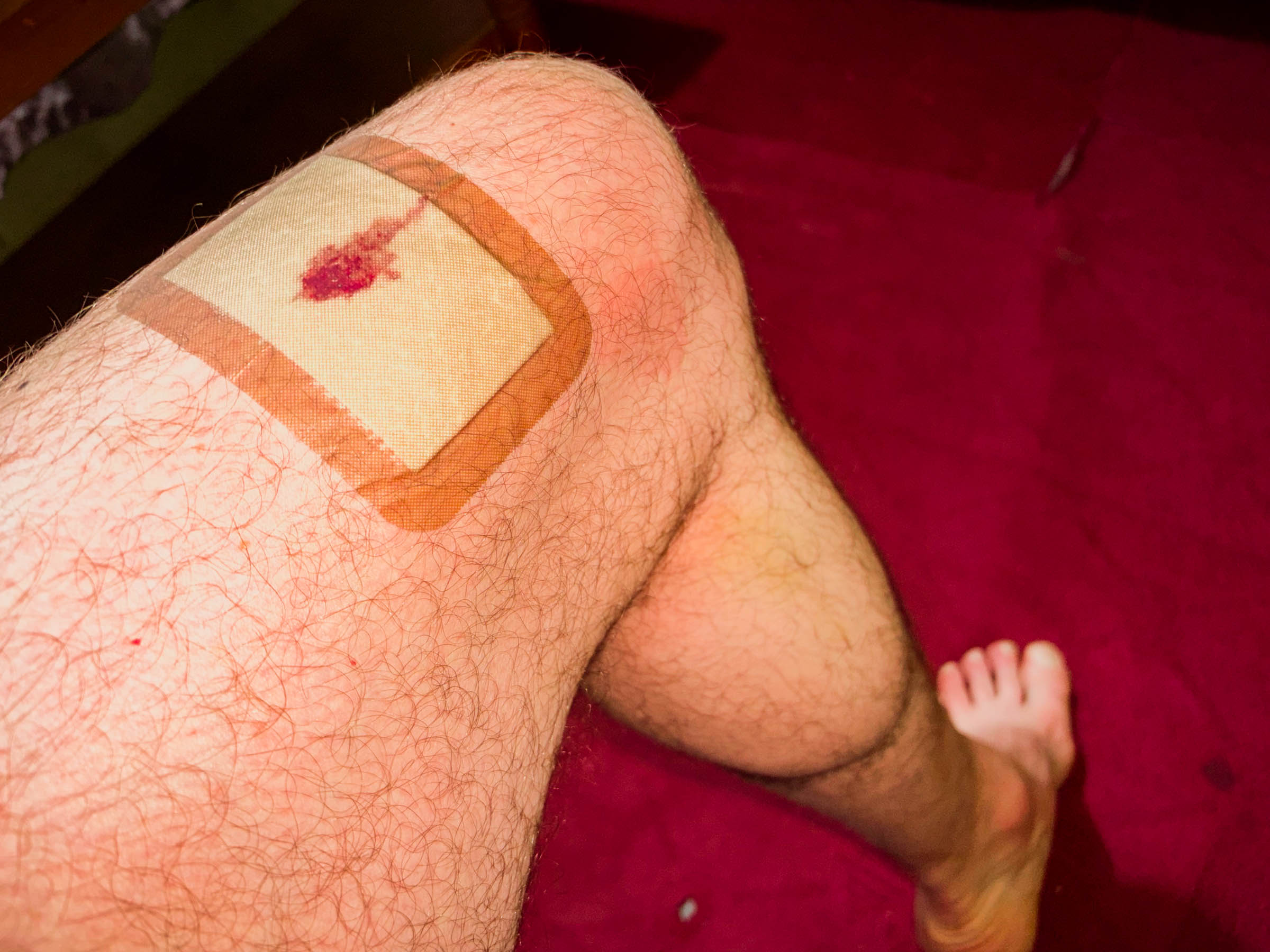
Leeches inject an anticoagulant; the bite bled for hours.
What’s being stumbling drunk right now?
At this point I imitated the bird noises and wind for a moment.
So that’s the Dharma before the wheel ever turned. Or maybe it is the wheel turning. Even that will someday go, though, right? Someday there will be no more birds, no one else to hear them, all destroyed. Will the Dharma still be rolling then? I say no. My understanding of the teachings is, nothing is permanent. But then, “nothing is permanent”—is that an enduring truth, or is that a temporary truth? If it’s temporary, does that mean that something lasts? I don’t know. Buddha’s middle way is to not commit to any dogma about any of this stuff.
For now, though, we can keep the wheel rolling, right? We are continuing this transmission. We are the link between the past generation and the next one, and we’re making big steps—we’re rolling quite a distance right now. Like, you two were our first jukais, keeping the precepts, maintaining them for the next generation. Sensei moved here and bought this place and founded a hermitage, and Gido helped choose a name and carved the plaque at the door, and Keishin and Monshin and I created a nonprofit, and we got our 501(c)(3) letter, finally, a couple of weeks ago. And Monshin is taking the step of becoming a senior student and leading us, and giving your first talk, keeping the voice of the Dharma rolling along—which is completely reckless. Being shuso is to get x-rayed; you will have no place to hide. Thank you for your courage. Yeah, you’re taking a big risk. Good luck. And thank you.